lightcurve-strategies


Need realistic exoplanet transit data for your test suite? lightcurve-strategies gives you Hypothesis strategies that generate physically valid jaxoplanet systems and light curves — complete with limb darkening, stellar surface maps, and configurable noise — so you can property-test your analysis pipeline against thousands of random-but-plausible scenarios instead of a handful of hand-picked fixtures.
What you get
Orbital & stellar strategies — generate TransitOrbit,
Central/Body Keplerian systems, Surface objects with
spherical-harmonic maps, and fully assembled SurfaceSystem instances
with a single function call.
End-to-end light curves — the light_curves() strategy wires up
system generation, flux computation, and noise injection in one step,
returning clean flux, noisy flux, and the noise realisation together.
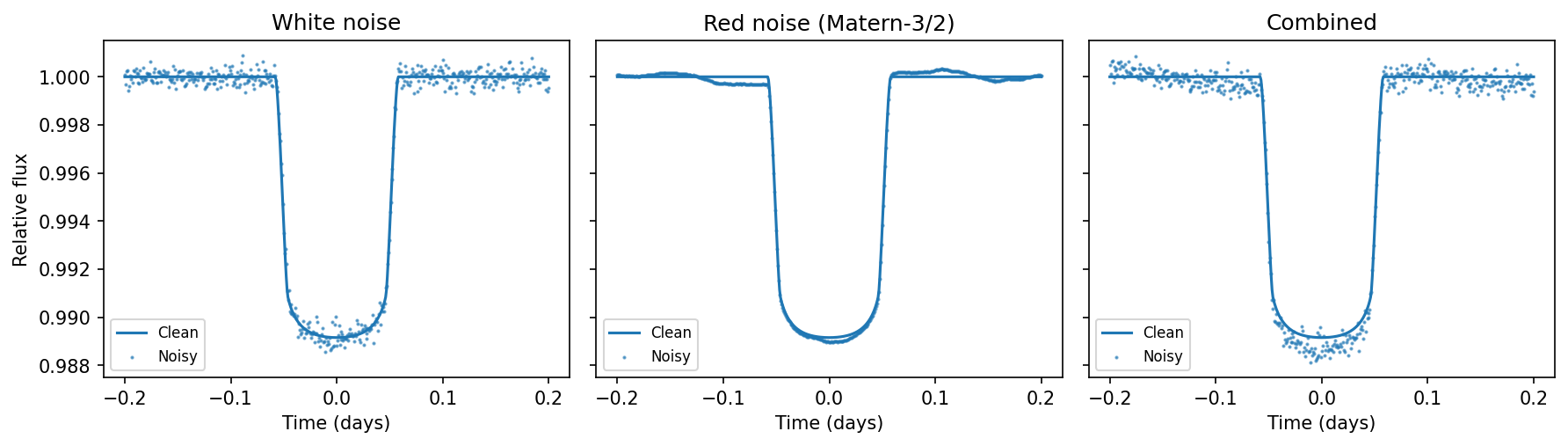
Pluggable noise models — white (Gaussian), red (GP-correlated via squared-exponential or Matern-3/2 kernels), or any combination. Seeds are Hypothesis-controlled for reproducibility and shrinkability.
Transit light curves
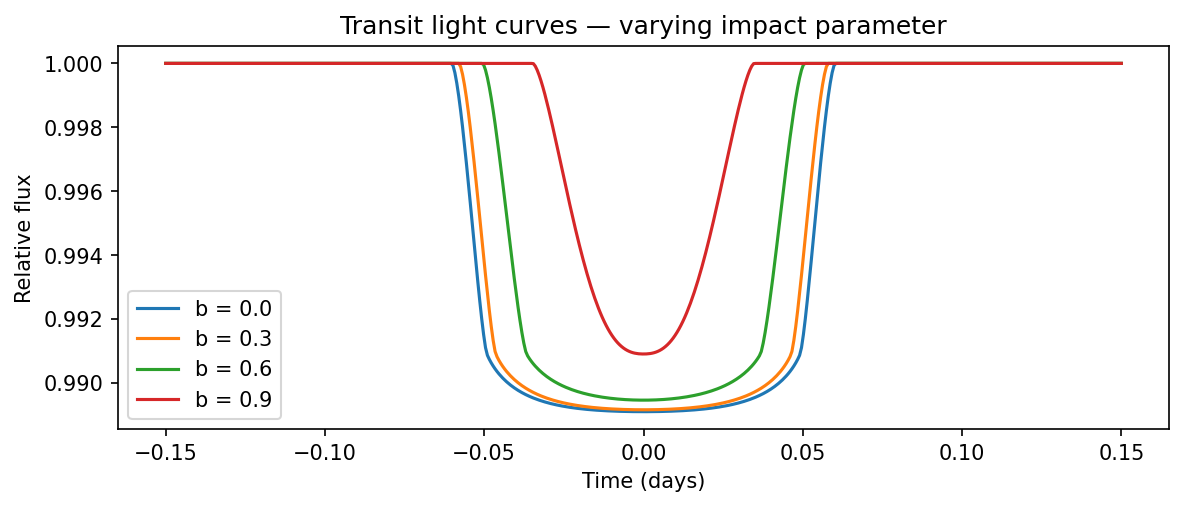
Generate transits across a range of orbital parameters. Each call to your test draws a fresh, physically consistent system:
Realistic noise injection
Layer white photon noise, correlated stellar/instrumental noise, or both on top of the clean transit signal:
Non-uniform stellar surfaces
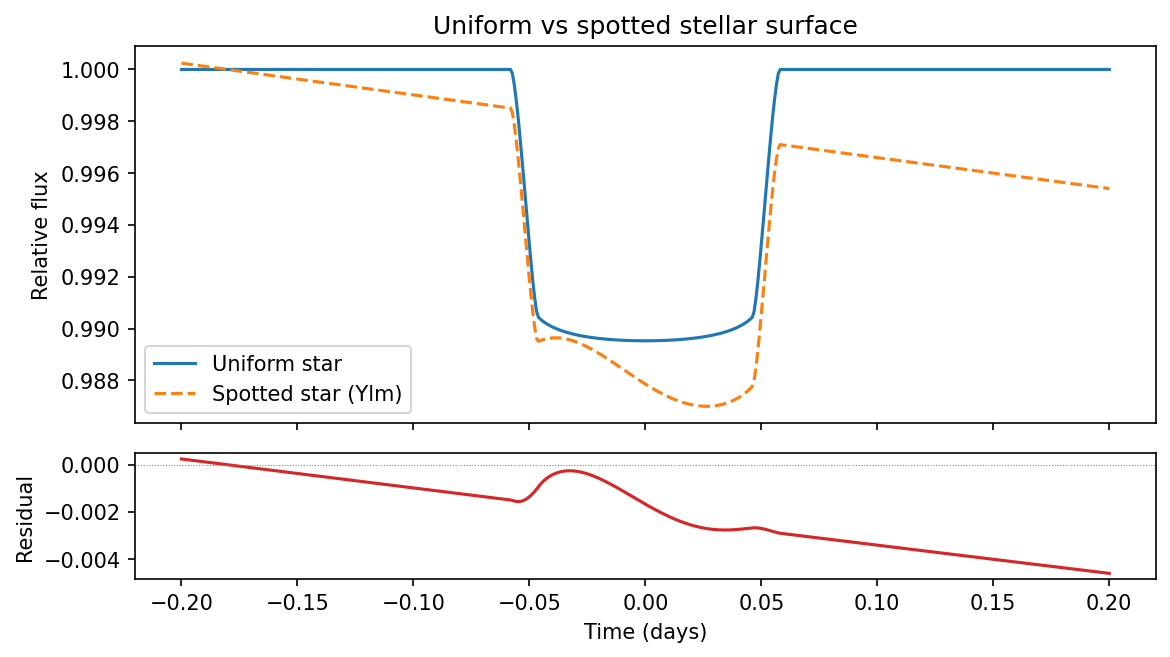
Test how starspots and surface inhomogeneities affect transit depth and shape using spherical-harmonic maps:
Quick start
pip install lightcurve-strategies
import numpy as np
from hypothesis import given, settings, strategies as st
from lightcurve_strategies import (
    centrals, bodies, surfaces, surface_systems,
    light_curves, white_noise,
)

time = np.linspace(-0.2, 0.2, 500)

system_strategy = surface_systems(
    central=centrals(mass=st.just(1.0), radius=st.just(1.0)),
    central_surface=surfaces(u=st.just((0.1, 0.3))),
    body=st.tuples(
        bodies(period=st.just(3.0), radius=st.just(0.1)),
        surfaces(),
    ),
    min_bodies=1,
    max_bodies=1,
)

@given(
    data=light_curves(
        time=time,
        system=system_strategy,
        noise=st.just(white_noise(scale=5e-4)),
    )
)
@settings(max_examples=50)
def test_transit_dips_below_baseline(data):
    """The stellar flux must never exceed the out-of-transit level."""
    baseline = data.flux[0]
    assert np.all(data.flux <= baseline + 1e-6)